
Elon Musk's SpaceX is famous for the kind of explosions that endanger wildlife, destroy fragile ecosystems, and put airline passengers in mortal danger.
But the company's latest explosion is happening here on earth. On the NASDAQ exchange. And it could potentially ignite the next Wall Street crash.
Even it the outcome isn't that severe, SpaceX could still cause significant damage to the retirement plans of millions of Americans.
Why? Because by the time SpaceX went public at a price of $135 per share on 12 June 2026, several Elon-friendly rule changes had been put in place to make sure SpaceX was added to crucial indices including the Nasdaq-100 and the Russell 1000 within days of its market debut.
What does that mean for retirement-oriented investors? As Danielle Liverance explained for 24/7 Wall Street on 21 July 2026:
If you own a Nasdaq-100 index fund in your 401(k), you probably bought SpaceX this month automatically. A rule change made the decision for you, and right now it is not looking like a good one.... Fidelity and other major 401(k) providers offer Nasdaq-100 index funds as core retirement holdings. Millions of everyday savers now carry SpaceX exposure inside their retirement accounts without researching the company or deciding it belonged in their portfolio.
Fortunately for some:
The S&P 500 excluded SpaceX for failing profitability and float requirements, leaving S&P index fund holders completely untouched by the forced buy.
If you're the kind of investor who leaves your retirement plan on "autopilot," you may now own a piece of SpaceX without even knowing it. And it may not be the kind of stock that helps you sleep soundly at night.
SpaceX stock soared, then plummeted back toward earth
As expected, early SpaceX investors reaped massive returns as the company released a limited number of shares to the public.
Meanwhile, those late to the party — the eager retail investors who got on board during the first days of trading — paid even more to buy into a money-losing company suddenly valued by Wall Street at $1.8 trillion.
The stock rose 19% on day one to close at $160.95.
For a little while longer, retail enthusiasm acted like a booster rocket, propelling the stock to a peak of $225.64 on June 16.
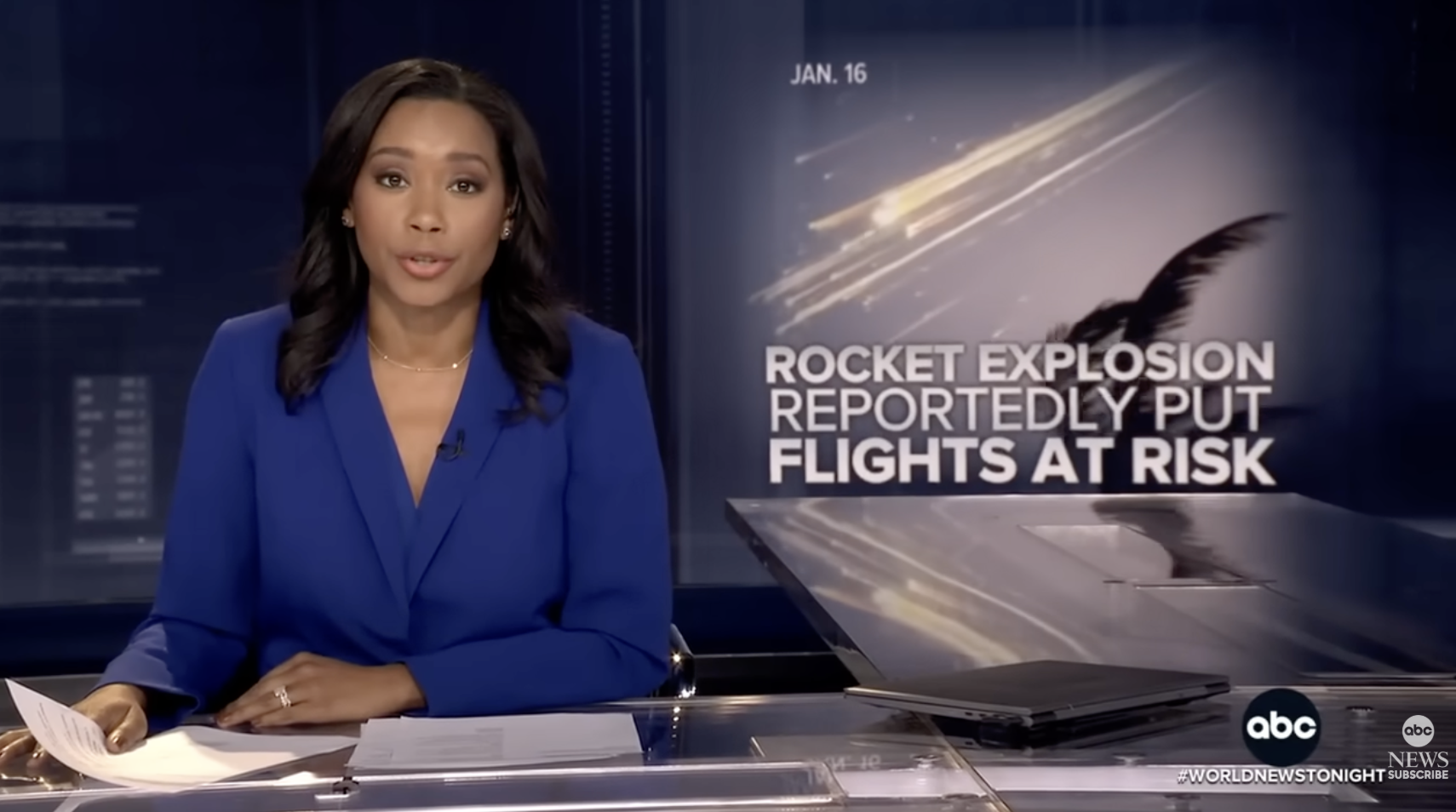
Then, almost as quickly, the kind of "rapid unscheduled disassembly" for which SpaceX has become famous began.
By the time SpaceX closed at $119.85 on July 20, it was down 47% from its June peak.
Even those "lucky" enough to get in at the IPO price were down 11%.
Despite the limited number of shares that were initially offered, the 401(k) investors whose funds were forced to buy SpaceX stock days after the opening paid an average price of $160 per share, according to 24/7 Wall Street. Those investors have already lost more than $1 billion.
"A collapse in the SpaceX price is a feature, not a bug"
As investor and market commentator George Noble said this week: "Everyone's a bag holder now."
According to Noble, "a collapse in the SpaceX price is a feature, not a bug," based on his conviction that: a) SpaceX is worth only about $30 a share; and b) insiders who bought in private placements at $10 and $20 will be looking to sell in the $120s at the first opportunity.
That first wave of insider selling could happen as soon as 6 August, two days after SpaceX issues its first earnings report as a public company, which triggers an unlock of 911.5 million shares. As these shares come onto the market, the same index funds popular with retirement investors will be forced to "rebalance" their indices by buying more SpaceX.
That dilution will continue on a quarterly basis, with hundred of millions of new shares potentially flooding onto the market each time, until after SpaceX's Q2 2027 earnings are announced.
Musk can sell his own 6.4 billion shares on 13 June 2027, 366 days after SpaceX went public.
Meanwhile, the same rule changes that have helped SpaceX prop up the value of its stock with Americans' retirement savings will also apply to large AI companies like OpenAI and Anthropic, if and when those money-losing companies go public.
All of which means millions of passive investors who are hoping to quietly build a retirement nest-egg with as little risk as possible will become even more heavily invested in the AI technology shift (or, as some call it, "bubble"), whether they like it or not.
Elon has a history of hyping investments — and misleading investors
From Dogecoin to Tesla to Twitter, Elon, of course, has made a hobby of committing securities fraud and misleading investors.

The price of Dogecoin famously plummeted 30% within hours of Musk’s SNL appearance on 8 May 2021 when Musk, playing a financial expert on Weekend Update, jokingly referred to the cryptocurrency as a "hustle." Five years later, Dogecoin trades at 7 cents, down 90% from its pre-SNL peak.
But despite all the financial damage he's caused, he's only ever been slapped gently on the wrist, giving him little or no reason to mend his ways.
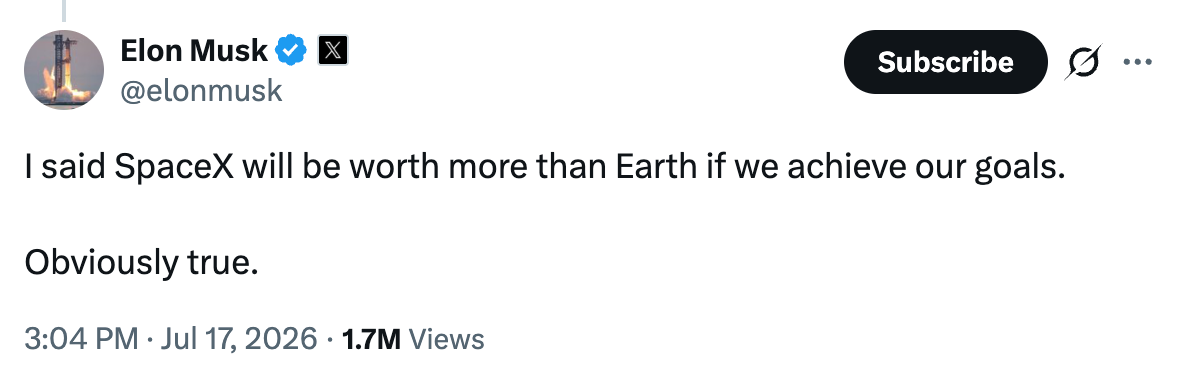
With SpaceX, Musk is promising to create a company "worth more than Earth."
But while millions of small investors may have bought into the hype, not everyone is on board the rocket ship.
Many investors are selling SpaceX short — betting the stock will continue to fall
As CNBC reported on 21 July 2026:
About 206 million SpaceX shares are now sold short, representing roughly 32% of the company’s publicly tradable float and about $25 billion in notional bearish bets, according to estimates from S3 Partners. That’s up from about 185 million shares, or 29% of the float, just last week, and marks a dramatic increase from an estimated 40 million shares, or roughly 5% to 7% of the float, about a month ago.
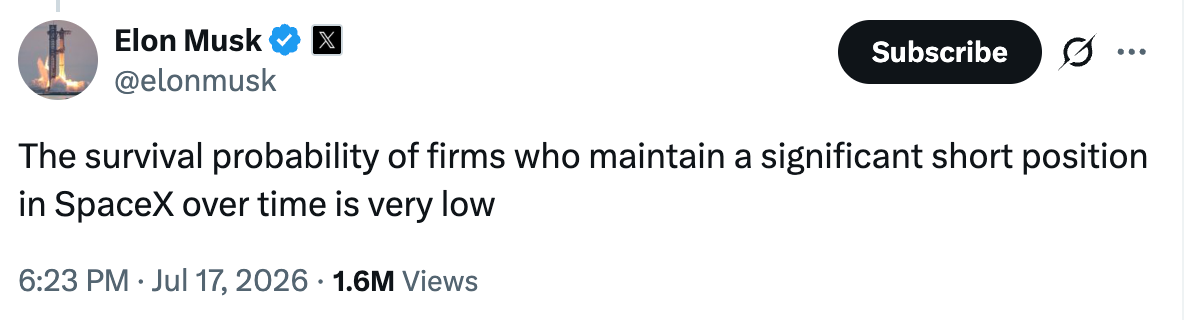
Musk lashed out at those who have turned bearish on SpaceX in a 17 July tweet suggesting they have little chance of survival.
The former trillionaire has, of course, made a habit of bullying and defaming critics who doubt his ability to deliver on his promises.
But Elon has failed before.
He's already 10 years late on his promise to deliver full self-driving cars.
It's five years since he hyped a silly meme coin to $0.73, disappointing everyone who believed it would go "to the moon."
So maybe he shouldn't be surprised that many people aren't willing to wait around for him to make SpaceX profitable.
Most people with retirement accounts aren't dreaming of colonizing Mars.
They're just hoping to retire on the beach with their 401(k)s intact.
Thanks for reading and sharing! And an extra special THANK YOU to all my paid subscribers*, past and present, and contributors to my "coffee fund." While paid subscriptions are always welcome, I’m continuing to offer all content free, so choosing a “free” subscription means you'll never miss an issue of UNPRECEDENTED.
To support this newsletter without subscribing, consider a one-time tip at Buy Me a Coffee.
*Subscriptions are billed to TLD Media, LLC
Subscribe to Unprecedented
Subscribe to the newsletter and unlock access to member-only content.