As I've detailed before, opposition to data centers is bipartisan, spans all age groups — and now surpasses opposition to nuclear power plants by a wide margin.
As I wrote more recently:
Because much of the current buildout has been driven by shady backroom deals and unjustifiable tax incentives, data centers have also become a symbol of how big corporations and corrupt politicians work together to screw the people.
The good news: Resistance is not futile. Some data center scandals can be averted.
There are examples on the list below that prove it — and many of those who have fought back against Big Tech are willing to share their secrets. Scroll to the bottom of this article for links to some valuable resources.
Here Are the 20 Biggest Data Center Scandals in America Today*
*Leave a comment below to tell me what I missed.
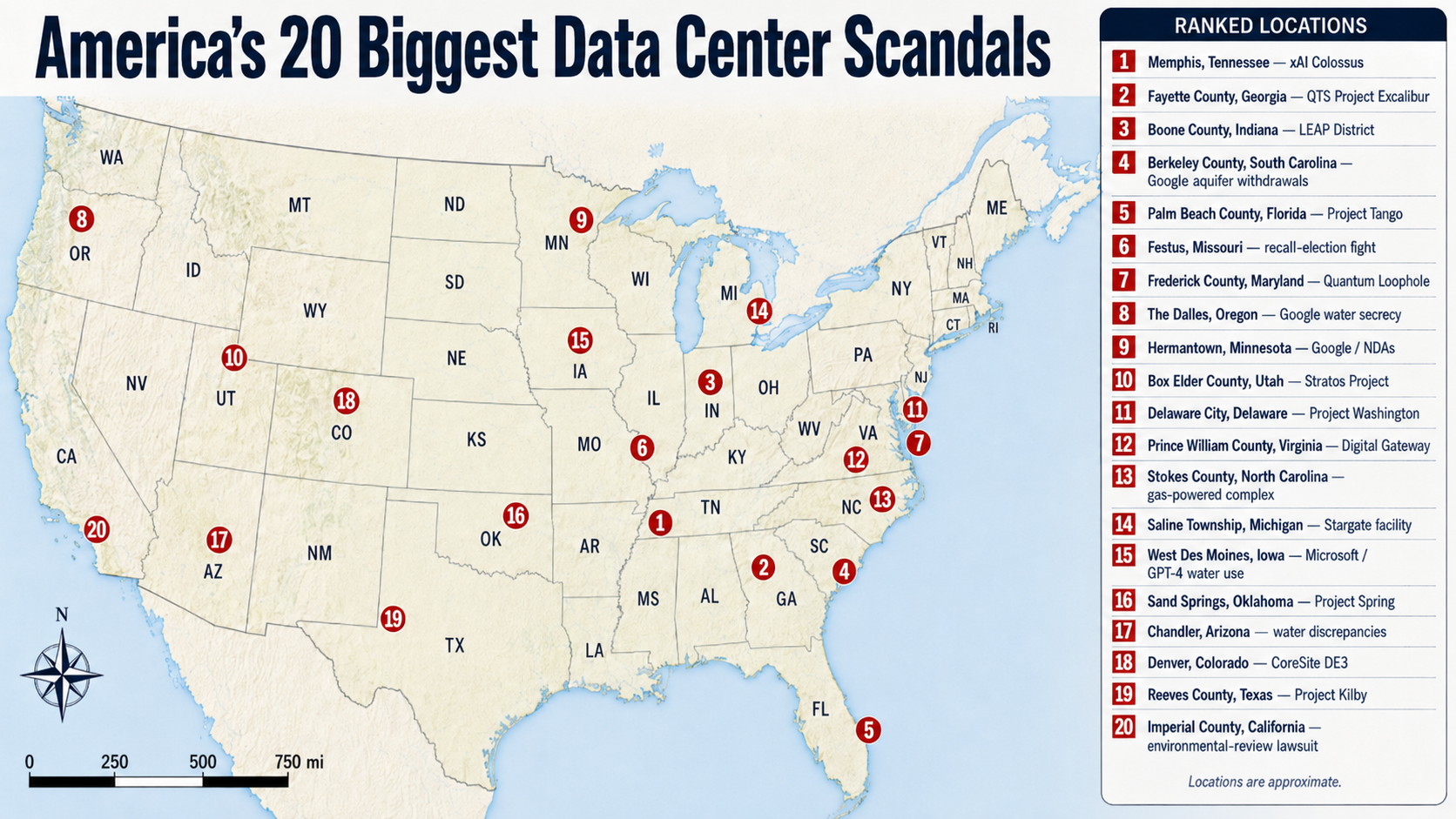
- Memphis, Tennessee: In 2024, Elon Musk built an illegal power plant to construct his xAI Colossus data center, creating a toxic nightmare for residents of a Southwest Memphis community already hard-hit by decades of environmental racism. Musk then applied a "cut and paste" strategy to massively expand the environmentally devastating Colossus construction into Southaven, Mississippi. In 2025, Trump's own EPA confirmed that Musk's poisonous generators were indeed illegal and needed permits. But that didn't stop Elon. Today, he continues to operate dozens of illegal gas turbines that spew smog-forming pollution, soot, and hazardous chemicals like formaldehyde. In a horrifying "fuck you" to the affected communities, Musk then decided to abruptly pause construction on a promised $80 million wastewater recycling plant. In June 2026, the Trump Justice and Defense Department's argued in court that Elon should be allowed to break any environmental laws necessary because xAI was not just essential to "national security," but also helping Trump bomb Iran.
- Fayette County, Georgia: In July 2024, residents in Fayette County, Georgia, were asked to voluntarily limit their lawn watering due to drought conditions caused by "unprecedented high demand for water due to irrigation activities." By 2025, residents of the affluent Annelise Park subdivision in Fayetteville began complaining their water pressure was unusually low. In 2026, it was revealed that Quality Technology Services' Project Excalibur data center had illegally "guzzled nearly 30 million gallons" of free water through "two industrial-scale water hookups" that went undetected for 15 months. Local officials told Blackstone-owned QTS to simply pay for the water it stole, without any additional fines. Construction at the site — and massive demand for local water — will continue through 2029. Meanwhile the whole state of Georgia is in the midst of a "historic drought" and "a record streak" of wildfires.
- Boone County, Indiana: Despite concerns that its $10 billion, 1,500-acre data center just north of Lebanon, Indiana, could strain water and power systems, raise electricity costs, and bring pollution and noise, while delivering relatively few permanent jobs, Meta broke ground on the controversial project in February 2026. Backed by "generous tax incentives" — and with "everyday Hoosiers" called upon to "foot the bill through higher monthly costs" — the Meta data center joins Eli Lilly’s ongoing construction of a $13.5 billion manufacturing complex in Indiana's planned 9,000 acre LEAP (Limitless Exploration/Advanced Pace) district. Because Lebanon "has little in the way of water resources," the state developed a $560 million plan to install 52 miles of new water mains which will draw from multiple sources to deliver up to 25 million gallons of water per day by 2031 to the LEAP district.
- Berkeley County, South Carolina: Secrecy and shady deals have been a hallmark of Big Tech's data center strategies since long before ChatGPT arrived on the scene. In 2019, as TIME later reported, Google asked if it could triple the amount of water it syphoned everyday from the Middendorf Aquifer, a "historically threatened" source. Why did it need all that extra water? Google said it was "a trade secret." Despite that, the South Carolina Department of Health and Environmental Control (DHEC) refused entreaties to put "citizens before search engines" and granted Google’s request, even as the DHEC told the local public utility it would need to reduce its withdrawal from the aquifer by 57% over the next four years.
- Palm Beach County, Florida: On Thursday 2 July 2026, just 20 or so miles from Mar-a-Lago, residents of the gated community of Arden in Loxahatchee, Florida, gathered in the Palm Beach County Zoning Commission hearing room to oppose the planned hyperscale AI data center known as Project Tango. The secretive project — rumored to be backed by Google — has relied on backroom dealmaking and administrative loopholes to balloon plans for a modest warehouse near an elementary school into a potential 1.8-million-square-foot hyperscale AI facility. Public outrage against the disastrous environmental, public safety, and cost implications of the project caused the zoning board to deny the requested expansion of the site by a 6-0 vote this week. But a larger hearing scheduled for July 15 means the zoning commission could still overturn that recommendation and approve the request.
- Festus, Missouri: If anywhere proves just how deep America's political rot festers, it's Festus. This April, the Missouri town mounted a massive, community-wide pushback against its corrupt political leaders, turning out in droves to oust four incumbent city council members whose backroom dealings had given the go-ahead to a $6 billion, 360-acre hyperscale data center. In May, the community gathered enough signatures to file recall petitions against three remaining pro data center council members, and the mayor of the town. Jefferson County Clerk Jeannie Goff verified that there were enough signatures to trigger the recall process. But in June, Festus City Attorney Brian Malone said the reasons for the recall were invalid and that the same council members who faced a possible recall should be allowed to vote on the resolutions. One of the new, supposedly anti data center council members (apparently out of fear of lawsuits) provided the deciding vote to reject the recall elections. Score another victory for Big Tech in its efforts to bypass traditional democratic constraints as its prioritizes limitless profit.
- Frederick County, Maryland: "Multiple pollution spills. Repeated stop-work orders. Failure to alert officials about an environmental violation." By June 2024, the Frederick County, Maryland, community was already "losing patience with the developer of a massive, multi-tenant data center complex." By 2026, the planned development zone for data centers had mushroomed to 2,600 acres. However, on 30 June 2026, even though 21,000 citizens — 6,000 more than required — had signed an petition to demand a voter referendum on the project, the Maryland Supreme Court ruled that Frederick County voters should have no say in the matter.
- The Dalles, Oregon: Google’s hub of data centers in this small Oregon town on the banks of the Columbia River "gulped down nearly 550 million gallons of water" in 2025. As The Oregonian reports, "That’s nearly 40% of all the water consumed in the entire city and a huge jump from the year before." Google's growing thirst will cause water bills to double over the next few years as the city struggles to upgrade its aging water system. How much water will Google need from The Dalles going forward? That's still a trade secret. Earlier this year, Oregon Gov. Tina Kotek went on the record to say that the demands data centers were making on her state's water and energy resources were "not sustainable."
- Hermantown, Minnesota: Citizens were already outraged when the Hermantown city council voted last October to approve a zoning change affecting 200 acres in a rural corner of the city, about eight miles west of Duluth. The zoning change made way for Google to draw up plans for a $1 billion data center in the small town — something opponents say will "fundamentally change the character of a rural neighborhood, depress property values, increase traffic and create noise and light pollution." A citizen's group called Stop the Hermantown Data Center has now filed a lawsuit to block the project, claiming that local county commissioners violated Minnesota’s open meeting law and weaponized NDAs to hide both the identity of the developer and the facility's immense water and power requirements from the public.
- Box Elder County, Utah: When Shark Tank's Kevin O'Leary tried to pitch northern Utah on "Stratos," a massive 9-gigawatt hyperscale facility that would dump 252,000 gallons of concentrated brine discharge into the fragile, shrinking wetlands of the Great Salt Lake on a daily basis, "Mr. Wonderful" instantly transformed into a supervillain. When he dismissed the outraged citizens, farmers, and environmentalists who rose up against his plan as protesters paid by China, things only got worse. Amid ongoing protests and lawsuits, the project has already been scaled back. Opponents are also challenging the jurisdiction of MIDA (Military Installation Development Authority), a state-created economic development entity that helped fast-track the project. MIDA has a history of "drifting far from its original purpose" to help strong-arm massive projects that gobble up resources while screwing locals.
- Delaware City, Delaware: Developers tried to bypass Delaware's landmark 1971 Coastal Zone Act with a plan to build a 1.2-gigawatt data center in Delaware City that contained 516 backup diesel generators. Following a public outcry, the state's Environmental Secretary Greg Patterson blocked the plan, but the appeals process could continue for years.
- Prince William County, Virginia: A years-long battle over a planned QTS data center ended 2 July 2026 when the Blackstone-owned firm dropped an appeal to the Virginia Supreme Court. The National Parks Conservation earlier slammed the "ill-conceived, destructive project" which "would have sacrificed more than 2,000 acres of historically significant land around the Manassas National Battlefield Park" to create 27.6M square feet of data centers.
- Stokes County, North Carolina: The community rose up in anger when in January 2026 the Stokes County Board of Commissioners voted 3-2 in favor of a proposed hyperscale data center complex on 1,845 acres of rural land, including sacred sites, "with no road or water infrastructure to support it." Following a citizens' lawsuit, the board voided its rezoning decision in April and the project is now back at square one.
- Saline Township, Michigan: It's cosily named "The Barn." But the facility now being built in Saline is actually a $16-billion gigawatt-scale data center campus that's part of the $500-billion Oracle and OpenAI Stargate project. Both the planning commission and the township board voted against the project. Twice. But after the billionaires sued and the town treasurer quit following death threats, the project moved forward. A beaming Gov. Whitmer joined Sam Altman and others at the construction launch.
- West Des Moines, Iowa: Most of the 26,000 customers of West Des Moines Water Works are residential. But five (soon to be six) are Microsoft data centers. Things came to a head in 2022 when the amount of water Microsoft needed to train ChatGPT models reached an "unsustainable" 6% of the utility's monthly supply. As data center developers target Iowa for its cheap land and cheap power, Iowa state Rep. J.D. Scholten is among those wondering, "if there’s enough water for both agriculture and all this."
- Sand Springs, Oklahoma: After a series of secret meetings with Google, the Sand Springs city council stunned the town of 20,000 with news that the tech giant would be building a data center on "827 acres of farmland that had been rezoned for industrial use." The town tried and failed to recall the entire city council. A conservation group is now suing, arguing that a conservation easement signed in 2013 prohibits industrial development on the site.
- Chandler, Arizona: Water is a hot topic in Arizona. As Simone Kjolsrud, the city of Chandler’s water resources manager said recently, "When Colorado River shortages hit next year, all of the cities around us are going to start pumping more, and we’re going to start to see aquifer decline." Secrecy about water usage was one of the reasons the Chandler city council voted 7-0 to reject a controversial new $2.5 billion data center in December 2025.
- Denver, Colorado: Only politicians with no qualms about environmental racism would think it's OK to put a massive new data center into the most polluted ZIP code in the United States. But the heavily Latino Denver neighborhoods known as GES (Globeville Elyria-Swansea) are exactly where a new CoreSite data center is being built. The scandal — including Jane Fonda-led protests — has forced Denver to declare a one-year pause on new data centers. But the moratorium came too late to stop the project in GES.
- Reeves County, Texas: One other way the AI data center boom is killing the environment is through the quiet abandonment of Big Tech's sustainability pledges. That tragedy is exemplified by Microsoft's Project Kirby, a planned data center in Pecos, Texas, that's close to the New Mexico border. The facility is expected to consume nearly 2.7 gigawatts of electricity (equivalent to about 2 million homes). And thanks to a new deal Microsoft just made with fossil fuel giant Chevron, it will pummel the area with "20 years of gas turbine emissions" that will make xAI's Memphis pollution seem like an ocean-scented breeze.
- Imperial County, California: At a time when the "mighty" Colorado River "has fallen to dangerously-low levels," developer Sebastian Rucci spent years reassuring the rural residents of California's Imperial County that his planned $10 billion, one million-square foot data center wouldn't need a drop from the Colorado. Even then, the fact the facility "could consume almost double the amount of electricity that the entirety of Imperial County used in 2024" was cause enough for concern. The legal battle over the development is ongoing. In the latest twist, Rucci is now suing the county and demanding access to 260 million gallons of water from the shrinking Colorado River each year.
Local Opposition Has Forced the Cancelation of Dozens of Data Center Projects
Even as Big Tech is pouring hundreds of billions of dollars into its massive, nationwide data center buildout, citizens of every political persuasion are teaming up to delay, block and even ban projects outright.
According to Heatmap, "25 data centers were scrubbed last year after local pushback — four times as many as 2024."
Here are some useful resources:
- In the face of ongoing environmental racism, the NAACP has issued these recommendations as part of the organization's Stop Dirty Data campaign.
- The Southern Environmental Law Center details how communities can engage most effectively on individual data center proposals in its free report: Getting It Right: Local Approaches to Data Center Development.
- Media Justice** offers The People Say No: Resisting Data Centers — a complete toolkit "aimed at helping communities cut through the propaganda, disinformation, and secrecy that are powering rapid data center development."
*This article lists the 20 biggest data center scandals I could find. Feel free to tell me any I missed in the comments!
**ICYMI: My April 2026 interview with Steven Renderos of Media Justice, who told me "the data centers and the newsrooms are not separate projects."
Thanks for reading and sharing! And an extra special THANK YOU to all my paid subscribers, past and present, and contributors to my "coffee fund." While paid subscriptions are always welcome, I’m continuing to offer all content free, so choosing a “free” subscription means you'll never miss an issue of UNPRECEDENTED.
To support this newsletter without subscribing, consider a one-time tip at Buy Me a Coffee.
Subscribe to Unprecedented
Subscribe to the newsletter and unlock access to member-only content.