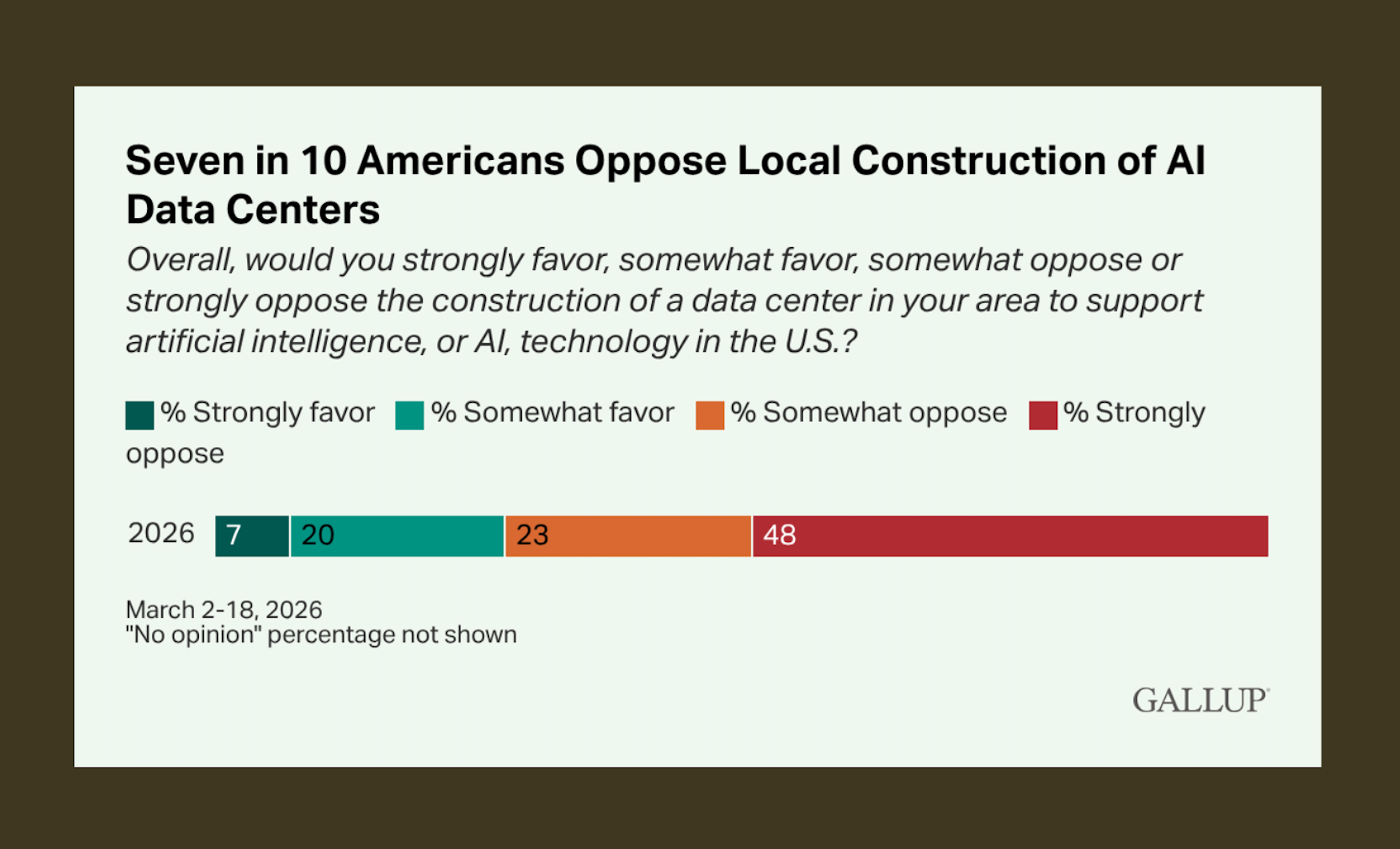
New research from Gallup shows that opposition to data centers is bipartisan, spans all age groups — and surpasses opposition to nuclear power plants by a wide margin.
The survey, conducted from March 2-18, shows that:
- 71% of Americans oppose local construction of data centers
- 48% strongly oppose
- Only 7% strongly favor
Among Democrats, opposition stands at 75%. Among Independents, it's 74%. And even among Republicans, it's 63%.
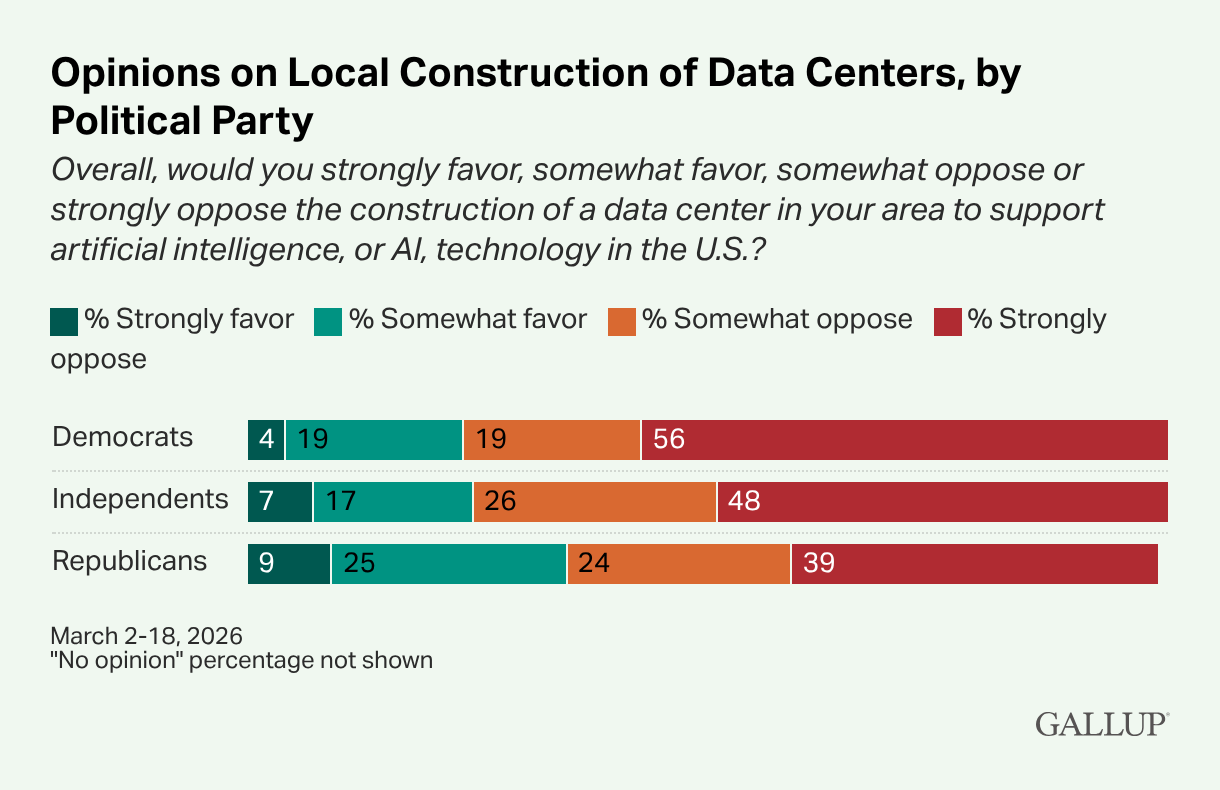
According to Gallup, women (55%) strongly oppose data centers more than men (43%), but "there are no meaningful differences in total opposition by age, race, education, income or urbanicity."
Meanwhile, opposition to nuclear plants, which Gallup, has surveyed since 2001 now stands at 53%, down from a peak of 63%.
Data centers are more unpopular than nuclear plants have ever been
When asked why they hated data centers so much, Americans' chief objections were related to the environment, quality-of-life concerns—and the potential for higher energy costs.
Fears about AI — and its overall impact on jobs, the economy, and society at large — were lesser factors in respondents' negative views toward data centers. (A 2025 Quinnipiac University poll found that Americans making $50,000/year or less were overwhelmingly negative about AI in general, while those making $200,000+ were overwhelmingly positive.)
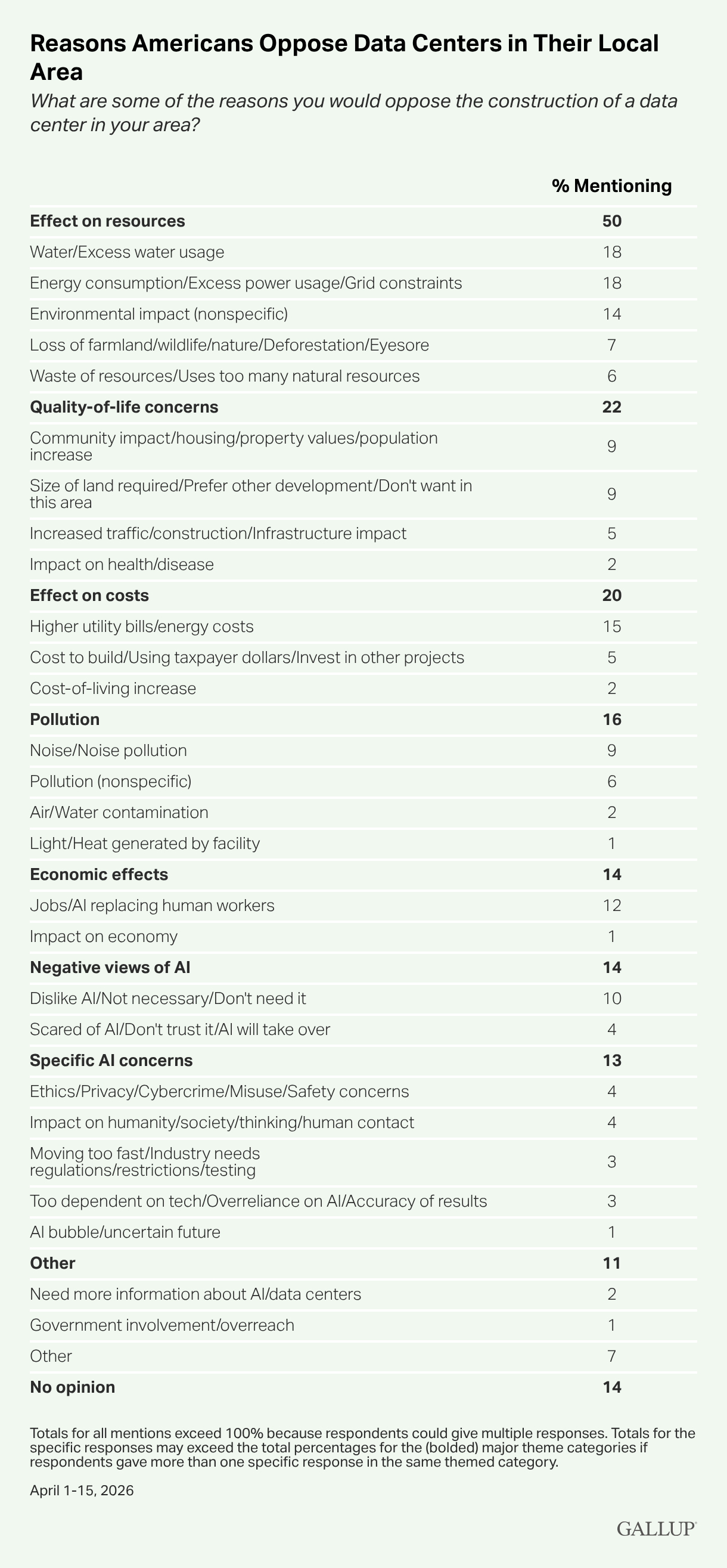
Those who support data center development focused on the perceived economic benefits, such as job opportunities, tax revenue, housing and infrastructure development. Relatively few respondents cited the potential benefits of AI to the country or themselves, personally.
Who's right about the (a) environmental and (b) economic impact of data centers?
As readers of this newsletter know, my default position is to be skeptical about the claims and promises of tech oligarchs who have already:
- Stolen all the world's knowledge and put it into "black boxes" they now want us all to pay to use
- Paid off government leaders in order to accelerate their sci-fi fantasies and entrench their already-unprecedented wealth and power
- Polluted communities with reckless development and a devastating disregard for natural resources and human life
So I'm also skeptical about the new marketing approach they're working on.
What's happening: Facing the intense, angry, and growing backlash to their data center plans, our tech overlords have, apparently, decided that their real problem has been their sales pitch, not the lived reality of everyday Americans.
The new pitch boils down to this: Our new data centers don't even use water! Your electricity costs won't go up! We're bringing jobs! We're boosting your economy! Let Silicon Valley take over the country and the wealth will finally trickle down!
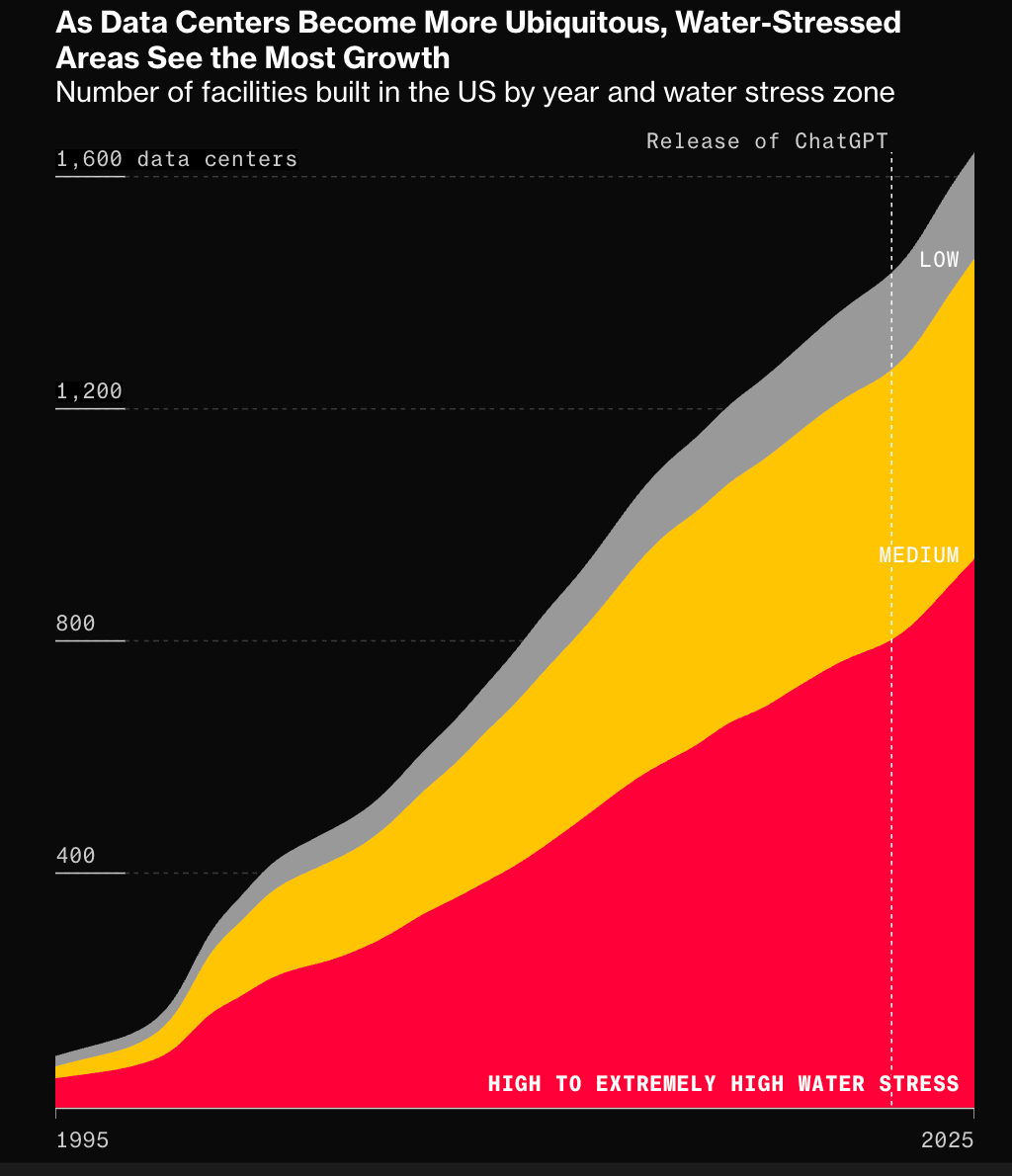
What's true about water: Most existing data centers use "open-loop evaporative cooling" systems that ensure that up to 85% of the freshwater used is permanently lost to the local watershed as vapor. Newer "closed-loop" systems—like those being marketed aggressively by Oracle—continuously recycle their water, resulting in up to 90% less local water use. The catch? Closed-loop systems require much larger physical structures, massive water pumps, and heavy-duty industrial fans. This creates a massive new demand for electricity from the grid and a huge increase in indirect water usage. The water consumption is not eliminated, it is simply shifted to the regional power utility.
What's true about electricity costs: In March 2026, the White House gathered executives from Amazon, Google, Meta, Microsoft, OpenAI, Oracle, and xAI to sign the "Ratepayer Protection Pledge." The catch? As with most Trump-connected promises, it's not worth the paper it's printed on. As Utility Dive reported in April 2026, "state utility laws are the primary barrier" to this pledge. To meet surging demand from data centers, utilities are forced to rely more heavily on inefficient fossil-fuel plants, even as they invest $1.4 trillion in rapid grid updates. And those capital expenditures will inevitably be passed on to consumers. A July 2025 white paper from Carnegie Mellon University notes that electricity bills could rise by as much as 25% in some regional markets by 2030 as a result of data centers, while greenhouse gas emissions from power generation would increase 30%.
What's true about jobs: "Tempted by promises of more jobs, tax revenue and the chance to be on the cutting edge of technology," 38 states currently offer financial incentives for data centers, noted Politico in April 2026. But 28 of those states are now rethinking the idea, in the words of North Carolina Gov. Josh Stein (D), that taxpayers should "subsidize data centers' consumption of energy and electricity when they make everyone else’s power bills go up?" A huge waste of taxpayer money: A May 2026 report from Brookings examined two kinds of data center facilities: a) hyperscale (built by cloud and AI companies—Amazon, Google, Microsoft, Meta—to run their own workloads); and b) colocation (built by data center landlords—Equinix, Digital Realty, CyrusOne—who lease space to remote tenants). Brookings found that actual job creation was less than promised in both cases, with virtually no growth in colocation counties, which saw "modest total employment effects but no significant information sector growth." Adding insult to injury: For colocations, taxpayer-funded incentives represented 62% of total investment (vs. just 2% for hyperscalers).
How will this all play out politically?
In The Atlantic, Lila Shroff wrote this week about the "emergent 'Bernie-to-Bannon' coalition" uniting people across the political spectrum who "think that AI is a disaster for the working class."
In April 2026, Anusha Mathur and Sanidhya Sharma wrote for NPR that data centers "could be a tipping point in the midterms."
Today, LOLGOP (Jason Sattler) posted a new conversation with Evan Sutton, a Seattle-based political strategist who helped organize Tesla Takedown.
As one of the key takeaways from that conversation, Sattler writes:
The data center fight is like the Elon fight in 2026. Musk’s Colossus facilities in Memphis are running methane turbines and poisoning historically Black communities. Across the country, these things are creating light pollution, noise pollution, air pollution, and driving up electricity costs. The resistance is the most cross-partisan organizing happening anywhere right now. Deep-red MAGA folks, DSA members, and suburban moms who’ve never voted before are standing at the same meetings. Democrats who don’t grab this issue by the horns are going to get left in the dust, and potentially outflanked by Ron DeSantis, who has very deliberately identified anti-AI as his lane to 2028.
But the tech fascists aren't going down lightly. As The New York Times reported on May 13 (gift link), the biggest donor in the midterm elections is VC firm Andreessen Horowitz, which "has extensive A.I. investments."
Andreessen Horowitz's political contributions of $115.5 million to date, when added to Elon Musk's $85 million+, means that two of the most dangerous right-wing lunatics in America will be spending more than $200 million to help Republicans smear and attack their political opponents. (A quick reminder that we should all be Defunding Fascism wherever we can.)
This massive Andreessen-Musk political spending will be in addition to all the ways that these villains will be using AI and social media algorithms to attack us with state propaganda, misinformation, and assorted psy ops 24/7 from now through November.
But we can still win if we stand together — and bring a few friends with us. Because everyone hates Elon. And, this year, everyone hates data centers, too.
Thanks for reading and sharing! And an extra special THANK YOU to all my paid subscribers, past and present, and contributors to my "coffee fund." While paid subscriptions are always welcome, I’m continuing to offer all content free, so choosing a “free” subscription means you'll never miss an issue of UNPRECEDENTED.
To support this newsletter without subscribing, consider a one-time tip at Buy Me a Coffee.
Subscribe to Unprecedented
Subscribe to the newsletter and unlock access to member-only content.