It's generally accepted that psychopaths have existed throughout history.
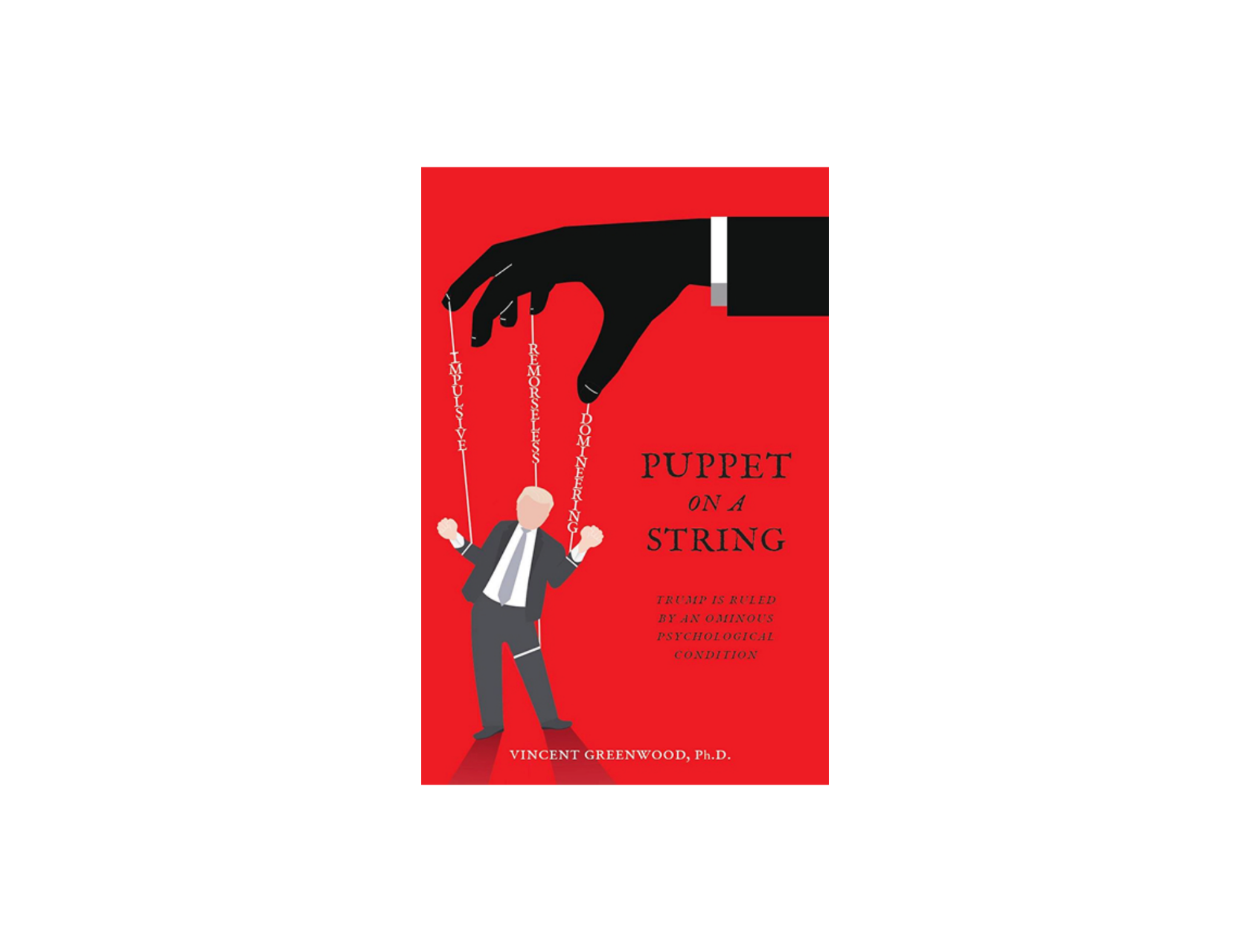
But as Dr. Vince Greenwood reminds us in his new book Puppet on a String, "psychopath" — derived from the Greek words psyche (soul) and pathos (suffering) — is itself a relatively new term, first coined by German psychiatrist Julius Koch in 1888.
Before that, criminals who exhibited what we would now call clinical psychopathy were said to suffer from "moral insanity."
I first interviewed Dr. Greenwood in 2020 about his diagnosis of Trump as a clinical psychopath. That diagnosis — and what it means for America and the world — has now been expanded upon in his new book which comes out on 22 September. In subsequent interviews, he correctly predicted how Trump's diagnosis would lead to "even more outrageous assaults" on our democracy if Trump lost in 2020 and, in 2024, the dangers that a second Trump term could bring.
In advance of his new book's publication on 22 September, I emailed him five new questions.
Q&A with Vince Greenwood, Ph.D.
1. What do you hope to achieve with this new book?
Three aims come to mind. First and foremost, Puppet on a String strives to educate the public about the condition with which the president is linked: clinical psychopathy. It is a fateful linkage with ominous implications since the condition of clinical psychopathy in someone comes with the promise of eventual harm to almost all in his orbit. And unfortunately, there is no known effective treatment for clinical psychopathy.
We cannot wish away this difficult reality, nor should we hope much for any amelioration of his condition. However, perhaps we can cope with it better if we acknowledge it and understand it better. This is the ‘duty to inform’ mission of the book: to contribute to an informed citizenry about the psychological and possible public health risks of the president.
Much of that information flows from highlighting the three traits that govern that condition: impulsivity, remorselessness, and a predator-like drive to dominate. Donald Trump is not an emperor with no clothes. Rather, he is "beautifully dressed" in clothes of superficial charm, glibness, persuasiveness, and infinite self-regard that mask his deceitful and selfish machinations, which are unfettered by any capacity for restraint, concern for others, and, when appropriate, the guardrails that 99% of us construct out of legitimate feelings of guilt, shame, or fear. Please be informed!
We cannot wish away this difficult reality, nor should we hope much for any amelioration of his condition. However, perhaps we can cope with it better if we acknowledge it and understand it better.
Second, Puppet on a String aims to underscore the validity and legitimacy of the assessment linking Donald Trump with this condition. This is because he was assessed using the gold-standard assessment process for this condition: the Hare Psychopathy Checklist. The Hare Checklist earns this acclaim and confidence because:
- It is supported by a research literature comprising well over a thousand peer-reviewed studies
- The Checklist is comprehensive in the breadth and quality of information required. The types of information that are most sought after include:
- Information from childhood, adolescence, and young adulthood.
- Information in which the trait is expressed in overt behavior (e.g., an instance of lying is privileged over an accusation of lying).
- Information that reflects typical functioning and lifelong patterns is privileged over descriptions of more flamboyant, occasional behavior.
- Information that is well-resourced, substantiated, and has some form of external validation.
- Information that lends itself to quantification
- The Checklist is considered rigorous as exemplified by the amount of advanced training required to administer it. Highlights of the training included:
- Overview of the theory and research on psychopathy and its measurement.
- How to collect and evaluate the quality of life history information from different sources.
- How to deal with conflicting data.
- Provision of extensive definitions and behavioral examples of checklist items.
- Use of case examples to learn to apply the scoring system.
- Feedback on videotaped case studies to increase inter-rater reliability and precision on the checklists.
- Other skills to ensure a reliable and valid diagnosis.
For assessing clinical psychopathy, a clinical interview is not required if you have sufficient life history information on the client, which we do for Donald Trump. He is arguably the most well-chronicled public figure in history. An interview with Trump is not necessary, given the storehouse of high-quality information available from other sources. Indeed, a personal interview is not only unnecessary but, according to some evidence, may even be undesirable. A core feature of psychopaths is deceitfulness. They lie casually and reflexively. They are not just unreliable reporters of their history but active dissemblers.
The assessment detailed in Puppet on a String is reliable, valid, comprehensive, and rigorous.
Finally, the book tries to fulfill a 'duty to warn' the public about Trump’s psychopathology. Clinical psychopathy is a singular condition in our field in which the cardinal features are all about the dangers posed to others. Our scientifically grounded assessment of Trump’s dangerous condition compels us, ethically, to share our findings with the public ("The traits are coming! The traits are coming!")
2. You state that Trump is a bundle of "psychopathic traits marketed as out of the box leadership." How has the media’s "sane-washing" of Trump helped obscure the presence of personality traits which, before the term psychopathy was termed, were described as "moral insanity"?
It can be maddening to acknowledge the success Donald Trump has enjoyed in the political arena. He seems particularly adept at what many refer to as the "dominance" mode of political theatre. In his excellent, evidence-based book, Comeback: Routing Trumpism, Reclaiming the Nation, and Restoring Democracy’s Edge (2024), Steven Fish, a political science professor at UC Berkeley, makes a persuasive case that politics is mostly a dominance game, a game of capture the flag. His money quote:
People favor leaders who they regard as strong, as capable of mastering their political opponents. If you look at the data, what you’ll find is that the candidates who are regarded as more knowledgeable win about half the time. Candidates who are regarded as "caring more about people like me" win about half the time. The candidates who were viewed as the stronger leader? They rarely lose.
Fish breaks down the art of political dominance into three areas:
- Reality-shaping
- Double down rather than back down when opinions don’t move the public in your direction.
- Pound your reality into voters’ heads.
- Engage in storytelling to connect the dots for voters.
- Conflict-embracing
- State controversial opinions. Do not retract. Move forward.
- Craft messages to stoke the base. Emphasize "us vs. them" framing.
- Language of the aggressor:
- Cast yourself as menacing, imposing, and dominant.
- Cast opponents as lame, unpatriotic, and disgraceful.
- Use language that is entertaining and transgressive.
There is a high road of high-dominance behavior. And then there is the low road of win-at-all-costs, marked by fact-free, conscience-free, and hyper-aggressive behavior. Welcome to the Trump expressway. He is good, really good at brawling in the political arena—a monster truck.
Here, we want to underscore the findings in Puppet on a String. Trump won the genetic sweepstakes to excel at low-road dominance politics. In that arena, he has the agility, speed, and strength to succeed.
The personality disorder equivalent of these athletic capacities is the clinical psychopathy core traits of drive to dominate, remorselessness, and impulsivity. Yes, what we have underscored as the dangerous core features of this disorder transform into certain skill sets that, unfortunately but realistically, are associated with the accumulation of political power. The clinical psychopath is like a cold-blooded machine designed to lie, dominate, and act without remorse. Dangerous though they may be, psychopaths have just the malignant charms to thrive in our current political environment.
While maddening at one level, we can use this perspective to break through the "sane-washing." We need to highlight that Trump is not a master of the political arts but a puppet to his traits, even if some of them align with certain political skill sets. Trump’s psychopathic aggression ("I like beating my enemies to the ground") and ability to lie with impunity platform his reality-shaping skills. We cannot forget that his penchant for embracing conflict stems from a serious deficit: he has no unpleasant feeling of fear or guilt that might serve as a brake on his impulses to take risks, divide the country, or normalize cruelty. His language of the aggressor mode is linked to the psychopath’s ability to embellish or disparage casually due to their glibness, egocentric superficiality, arrogance, and sense of entitlement to deference from others.
The awareness of his psychopathology can help us not get sucked into his boasting, bullying, and bravado. He is not dominant, but fundamentally submissive. He is not the master of his fate, but a puppet on the strings of his condition.
3. Trump has put the country on a trajectory defined by chaos, indecency, and corruption. You write that "his only limit is what others will allow" — and you quote Susie Wiles saying much the same thing. How scared should we be about what’s still to come? How worried are you about a possible attack on the midterms?
Very worried. We are sinking into a state of personalistic rule driven by the implacable traits of clinical psychopathy. The chaos we are experiencing largely flows from impulsivity, characterized by a lack of restraint and dereliction. Because of his impulsivity, Trump can’t help but:
- Act quickly without considering the consequences
- Continue to display no aptitude for governance
- Fail to plan or persevere with any substantive task
- Lurch from one egocentric need to the next
The lack of decency we’ve recently observed largely flows from the remorselessness trait. Because of his inability to feel guilt or shame, Trump can’t help but:
- Blithely ignore democratic norms, the tragedy of lost lives, or appeals from anyone to rein in his reckless and derelict behavior
- Have no feeling of discomfort about the suffering of others
- Fail to recognize the indecency and damage he wreaks because he is undaunted by the fear of punishment
"Trump can’t help but . . ." is the tough clinical reality of psychopathic traits that account for the frightening roller coaster ride the country is taking, lurching this way and that, with no guardrails of probity or deliberation. Susie Wiles, the Chief of Staff, affirms there is cause for worry when she notes that Trump "operates [with] a view that there’s nothing he can’t do. Nothing, zero, nothing."
We can no longer take the cornerstones of our democracy for granted. As Bruce Springsteen noted in a lyric in Atlantic City (1982), noting the mafia takeover in that city:
Down here it’s just winners and losers
And don’t get caught on the wrong side of that line
Increasingly, it looks like America is crossing over that line.
4. You note that "there is a good fit between the strongman traits that predict an authoritarian takeover and psychopathic personality disorder," but you predict that Trump — a puppet controlled by a hardwired disorder — won’t succeed in becoming a dictator. But if Congress continues to enable him for two more years — and if the tech oligarchs and "true believers" are determined to consolidate their power — could we be looking at something even worse in 2028?
Yes, there is a kind of natural fit between the pathology of clinical psychopathy and some of the noted strategies associated with an authoritarian takeover. Strategies highlighted by authoritarian scholars such as Ruth Ben-Ghiat and Jason Stanley that align with the drive to dominate cluster of traits include:
- Promote hierarchical thinking
- Magnify law and order concerns
- Emphasize ‘us’ vs. ‘them’ messages
- Project hypermasculinity and invincibility
- Blatantly engage in corruption to underscore dominance
- Encourage a cult of personality
Authoritarian strategies that align with the remorselessness cluster of traits include:
- Shatter norms
- Encourage political violence
- Exploit vulnerable populations
- Demonize cities
- Act with impunity
However, I also want to note that the full lineup of psychopathic traits is not a perfect fit for the consummation of a smooth-running autocratic state. The marked impulsivity and dereliction of the clinical psychopath are kryptonite for any sustained or effective governing, whatever the ideological leanings of the state.
Trump’s lack of restraint and disinhibition also undermines the consolidation of an effective authoritarian state. The expression of this trait in the clinical psychopath is uncompromising. Trump can’t help but act quickly in an "I’ll do what I damn well please" manner to situations—mostly slights—that evoke his grievance, vengeance, need to be admired, and trolling impulses.
These psychopathic drives take up his focus and behavior. His condition doesn’t allow for any strategic thinking to achieve a more durable authoritarian state, and he doesn’t have the patience or humility to follow the advice of the Heritage Foundation or other right-wing thinkers.
An autocratic state that destroys our liberties and cements a radical disparity of wealth is a woeful scenario. What I think is even more likely is a failed state, where arrogance, deceit, cheating, impulsivity, and remorselessness have had their way with our hard-earned freedoms, bounty, and national spirit.
5. Finally, you and others have been sounding the alarm about Trump for years. George Conway even started the Anti-Psychopath PAC in 2024. What good does understanding Trump’s psychopathic personality disorder do for us now? Put another way, once people fully grasp that Trump suffers from psychopathic personality disorder, what can they do with that knowledge?
The short, practical answer is to get yourself and 10 democracy-loving friends to the polls.
The answer from the book is to Paul Revere the message that our president suffers from a precisely delineated, empirically supported, and dangerous personality condition: clinical psychopathy. What kind of threat does a clinical psychopath in the Oval Office pose? Their impulsivity, lack of empathy, and arrogance result in their inability to act predictably, react calmly and without aggression, examine their own behavior and accept responsibility, respect boundaries and limits, and place others’ interests or the common good above their own. Trump’s traits have infected the body politic. To a shocking degree, cruelty, nihilism, and deceit have become normalized in our civil society and political class. Many have offered critical appraisals of the president’s personality and conduct, including informed opinions from mental health professionals; but those opinions have only gone so far. With the analysis provided in Puppet on a String, we now have the receipts to back up our concerns about his ominous condition. We can’t submit to charges of ‘Trump Derangement Syndrome’. We need to break through the sane-washing, restore our democracy and sense of decency, and call out and resist the clinical psychopath.
Please be informed. November is coming.
If you want to read more about this analysis of Trump’s condition, Vincent Greenwood, Ph.D.'s new book Puppet on a String: Trump is Ruled By a Dangerous Psychological Condition comes out on 22 September and is available for pre-order now from Bookshop.org, Amazon, Barnes and Noble, Books a Million, or from your local bookstore. Find more about it online at DutyToInform.org.
Thanks for reading and sharing! And an extra special THANK YOU to all my paid subscribers*, past and present, and contributors to my "coffee fund." While paid subscriptions are always welcome, I’m continuing to offer all content free, so choosing a “free” subscription means you'll never miss an issue of UNPRECEDENTED.
To support this newsletter without subscribing, consider a one-time tip at Buy Me a Coffee.
*Subscriptions are billed to TLD Media, LLC
Subscribe to Unprecedented
Subscribe to the newsletter and unlock access to member-only content.