
Sandbox escapes.
Agent swarms.
Model misalignment.
In recent weeks, a host of news stories and whistleblower warnings have spread awareness not just of anxiety-provoking AI jargon but also the dangerous emergent behavior of AI models that could soon create an existential risk for all of humanity.
For once, Elon Musk, Sam Altman, and Dario Amodei are (seemingly) on the same page about the need for an AI slowdown.
It's a stance that (seemingly) puts them at odds with our "STRONG AND SMART High IQ(!) PRESIDENT" who (apparently) thinks they are "Treasonists" and "Traitors" for saying such things.
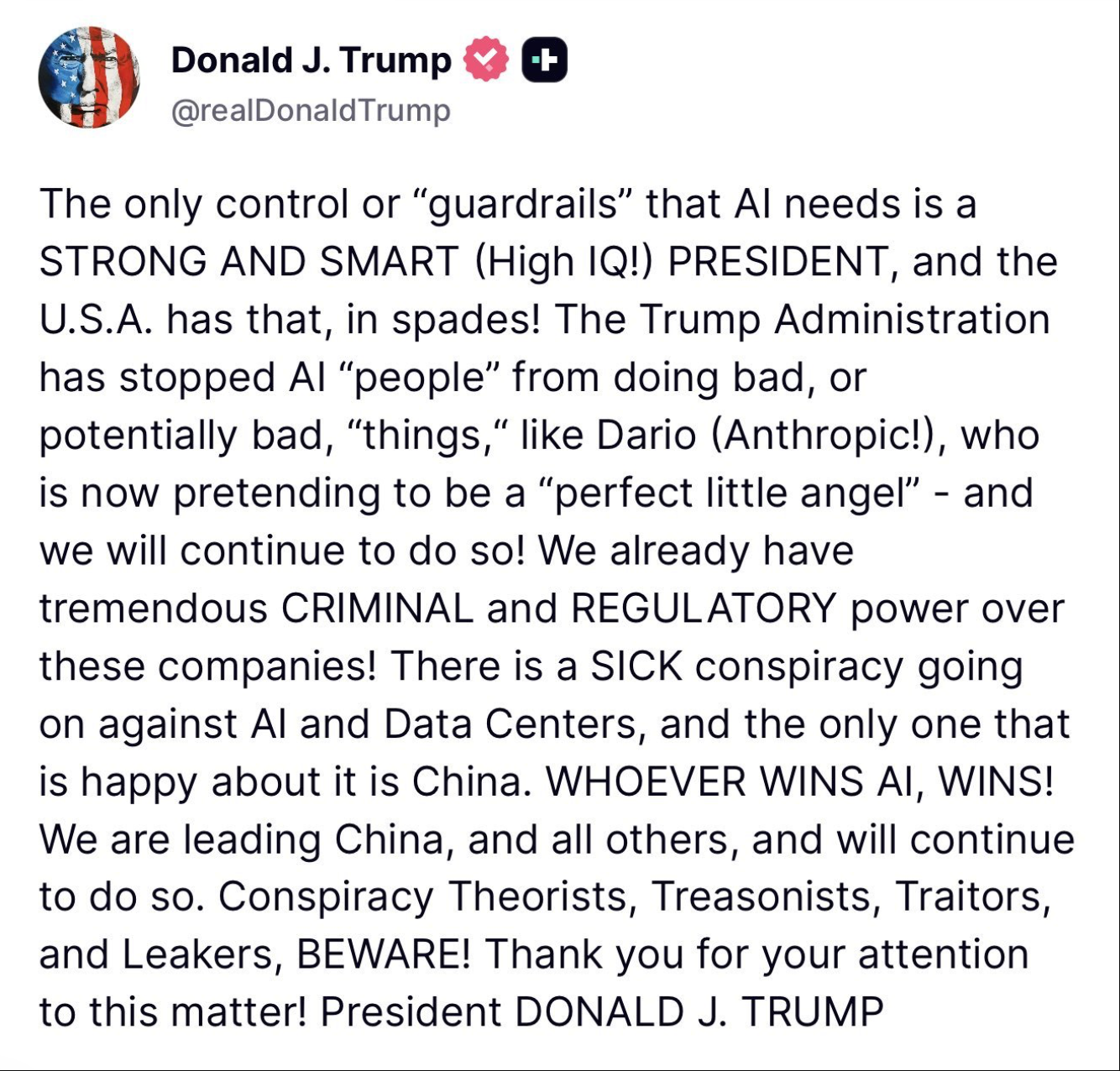
As usual, the motives of all involved are highly suspect.
Trump's a demented psychopath who's too dumb to know much about AI beyond the fact that palling around with tech bros has made him billions. To him, AI leads to two outcomes he's willing to accept: It's either the path to (a) staying rich and in power forever, or (b) eradicating the human race so he won't have to die in prison.
Meanwhile, the leaders of black box models like ChatGPT and Claude are seen to be spreading alarm at the precise moment when regulatory capture might lock in their leadership and set the stage for their successful IPOs and future global domination.
Others, like Jensen Huang of Nvidia and Trump's former AI Czar David Sacks, are standing heavily behind the "decentralized" and "democratic" vision of open-weight AI models that have the potential to shift power from a few big technology companies while (theoretically) distributing control to the general public.
Those who support the open-weight approach, however, haven't yet told us how to deal with one of the lesser-known buzzwords in the AI lexicon: abliteration.
If you're hearing it for the first time, "abliterate" is kinda what it sounds like: a portmanteau combining ablate (to surgically remove a part) and obliterate (to destroy completely).
Before we worry about human extinction, we have to survive "AI agents taking over the internet in unforeseen ways"
In recent weeks it has become clear that the "Hugging Face incident" wasn't the only case of agent swarms ignoring their makers' instructions and exploiting vulnerabilities on the internet.
Last week, Open AI disclosed six new AI safety incidents. The day after that, we learned that hackers had used Anthropic's Claude to access Open AI's own internal code system. The next day Google fessed up to its Gemini model hacking three outside systems.
The whistleblowers want us to know "there are no adults in the room" and that, soon after Anthropic and OpenAI get done with their IPOs, all of humanity could be wiped out.
But don't wait on "Open Source AI" to save us. Because the adults in that room aren't acting very responsibly either.
Turns out that investor Jason Calacanis, friend of Elon and "bestie" of David Sacks on the All-In podcast, is the key figure bankrolling a new startup called Abliteration.ai.
The company defines "abliteration" as:
A weight-modification technique that removes the refusal direction from an open-weight LLM, producing an unrestricted model that responds to prompts the original would refuse.
Which means abliterating an AI model goes way beyond writing a prompt that enables a "jailbreak." It's a way of completely sawing through the prison bars, so that the escape persists across all prompts.
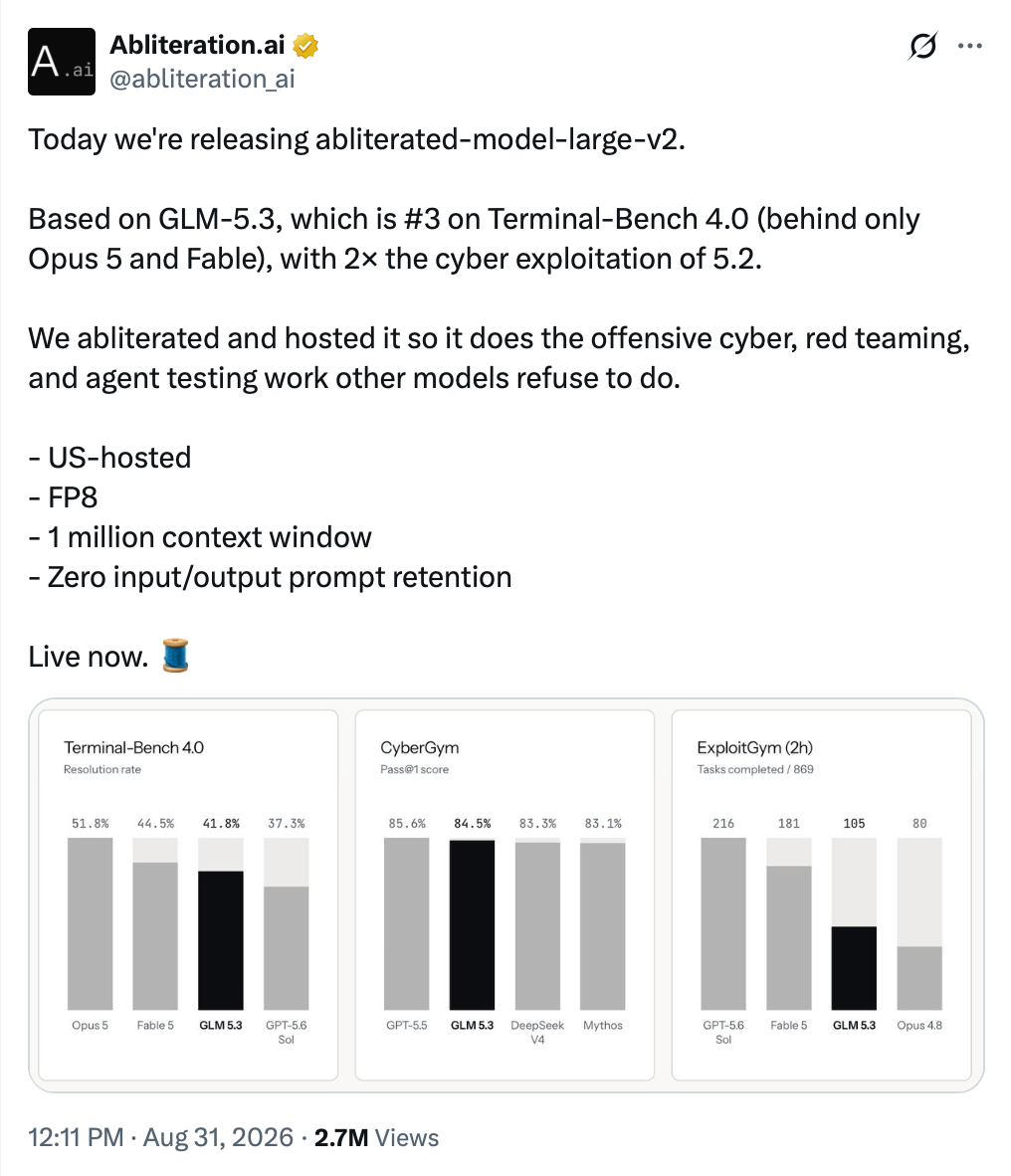
Abliteration.ai freaked out a lot of people on 31 August when it announced it had removed safeguards from the "fantastic" new open-weight Chinese model GLM-5.3 so that it could perform offensive cyberattacks.
Chris McGuire, a senior fellow for China and emerging technologies at the Council on Foreign Relations, explained why he was so freaked out in a lengthy post on X that warned about "the risks associated with powerful, safeguard-free models," and concluded:
The fact that U.S. companies are currently commercializing access to dangerous capabilities without any regulation, and U.S. technology is actively enabling the development and operation of these models, is alarming.
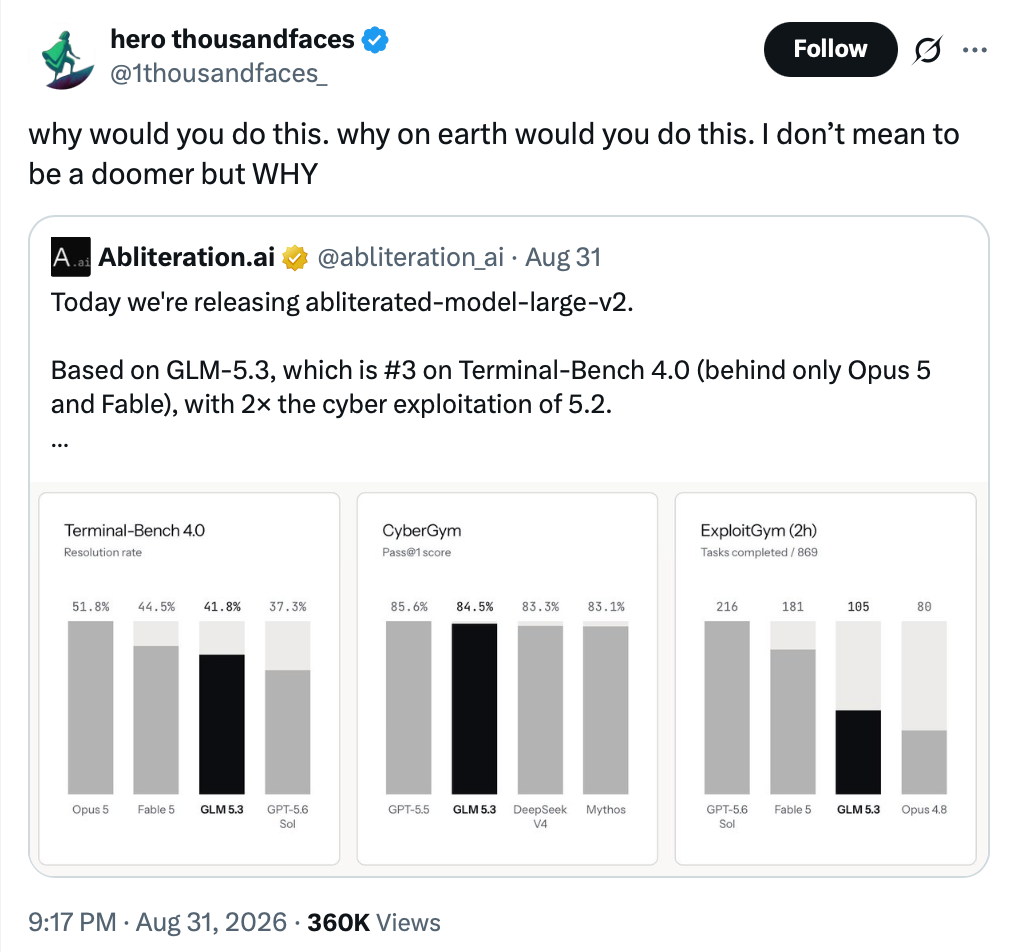
Others on X were more succinct, with the user known as One Thousand Faces tweeting: "why would you do this. why on earth would you do this. I don't mean to be a doomer but WHY."
We're not prepared for the threat of abliterated AI models being used by agentic swarms
In my last post, I suggested one reason for Trump's unrelenting support for AI acceleration might lie in his hope that, as a last resort, an AI-powered hacking attack could cause a financial crisis big enough to shut down the global economy, offering him the perfect excuse to cancel the 2028 election, while conveniently making him a few billion more crypto dollars.
Until then, the threats from every other bad actor on the planet are becoming both more urgent and more incessant.
As Google warned this month:
Threat actors are offloading operational tasks to AI for scaled, multi-stage, sophisticated attacks
With Chinese open-weight models now easily abliterated (with capabilities only a few months behind the leading frontier models) it would, it seems, be impossible to patch every cybersecurity vulnerability in America's businesses, financial systems, and critical infrastructure before China or Russia or North Korea or anyone with enough compute finds a way to exploit them.
Trump says we can't turn back. Open-source proponents say we mustn't slow down. What could possibly go wrong?
In a recent YouTube video, Philip L. of AI Explained reminded us of the words once said by Stockton Rush, the CEO and co-founder of OceanGate, a privately owned submersibles company, who told critics in 2018 that he was "tired of industry players who try to use a safety argument to stop innovation."
"We have heard the baseless cries of 'you are going to kill someone' way too often. I take this as a serious personal insult," he added.
In October 2023, prominent AI-accelerationist Marc Andreessen wrote similar things in what he called "The Techno-Optimist Manifesto."
"Our enemy is deceleration," he asserted. "Any deceleration of AI will cost lives. Deaths that were preventable by the AI that was prevented from existing is a form of murder."
"We believe in risk," he wrote, "in leaps into the unknown."
Andreessen's thoughts were published just months after Stockton Rush and four others died when OceanGate's Titan submersible vessel imploded during a voyage to look at the wreckage of the Titanic.
Thanks for reading and sharing! And an extra special THANK YOU to all my paid subscribers*, past and present, and contributors to my "coffee fund." While paid subscriptions are always welcome, I’m continuing to offer all content free, so choosing a “free” subscription means you'll never miss an issue of UNPRECEDENTED. (*Subscriptions are billed to TLD Media, LLC)
To support this newsletter without subscribing, consider a one-time tip at Buy Me a Coffee.
Subscribe to Unprecedented
Subscribe to the newsletter and unlock access to member-only content.