Amid all of the outrages of the second Trump regime, one of the most disturbing for our nation's future (as I wrote in September 2025) is the reality that "a handful of regime-friendly oligarchs are seizing control of the data, the algorithms—and the narrative."
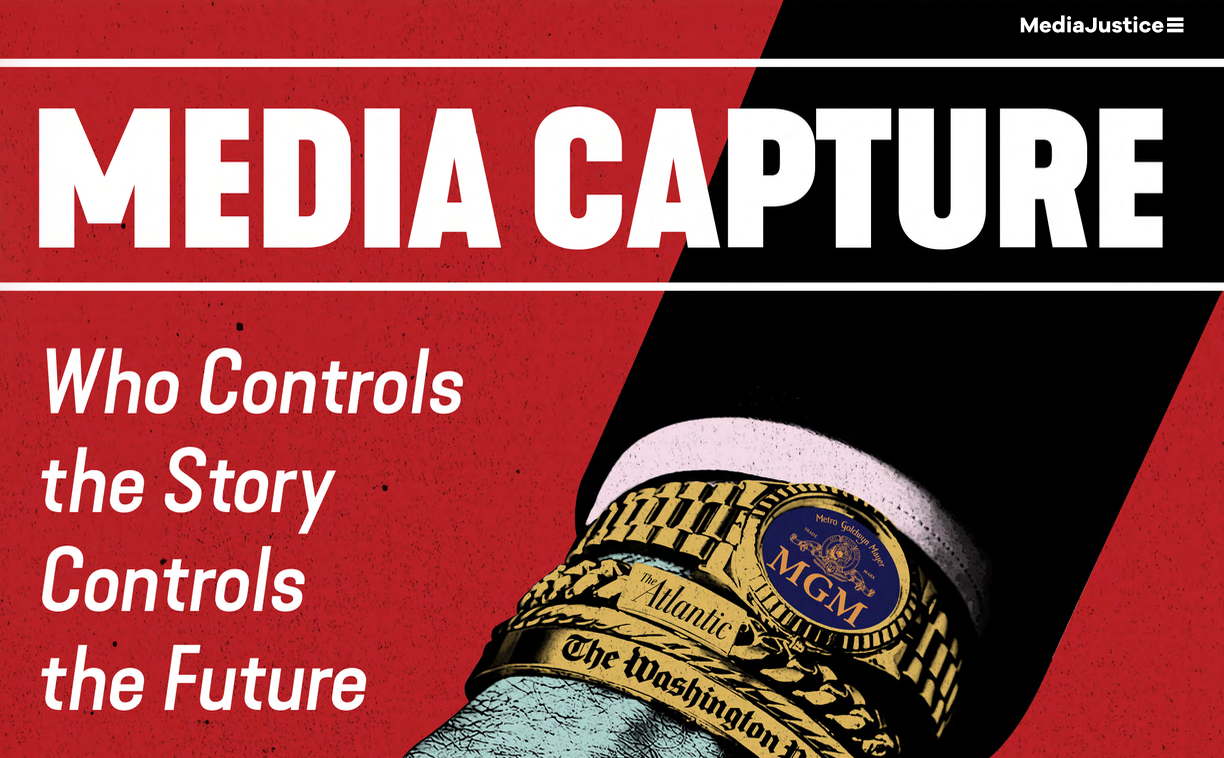
The full extent of the outrage is brought home in "MEDIA CAPTURE," a new 26-page report from Media Justice, a non-profit with a mission to "challenge how corporations and governments use media and technology to shape our collective future."
The report's Executive Summary begins like this:
Tech oligarchs are capturing America’s media system. They’re doing it through three interconnected strategies: buying media companies outright, creating financial dependency through funding and AI partnerships, and controlling the platforms where most people get their information.
Clearly, this affects us all.
But as the report's author Steven Renderos makes clear, media capture affects some more rapidly—and more profoundly—than others:
Media consolidation is a racial justice issue. When fewer companies control more of the media system, the communities with the least political and economic power lose their voice first.
I reached out to Renderos with a few questions about his report — and to find out what advice he has for you, me, and anyone else who wants to fight back against media capture — and, to quote Media Justice, "reclaim our media and technology for the collective good."
Q&A with Steven Renderos of Media Justice
Why is the convergence of media ownership, data centers, and AI so significant—and what risks does it create that didn’t exist before?
Honestly, there's nothing new about the richest people in society also owning the media. Power has always understood the importance of shaping hearts and minds. Being Salvadoran, I think about Las Catorce Familias, the coffee oligarchy that ruled El Salvador for nearly a hundred years. They controlled the land, the economy, and owned the newspapers. So while it might seem like a new thing with Larry Ellison bankrolling the purchase of Warner Bros Discovery, it's actually an old playbook.
What's different today is the scale of extraction required to make the tech oligarchy's wealth real. The promise of AI isn't just software. It's physical. It demands hyperscale data centers that strain local water supplies, push up utility bills, and reverse what little progress we've made on climate. The supposed benefits of AI require a massive displacement of labor and deeper exploitation of low-wage workers. Communities of color are bearing that cost right now, in real time, while a handful of billionaires get richer off our data, our land, and our labor. That's the part that feels new. The extraction has gone deeper.
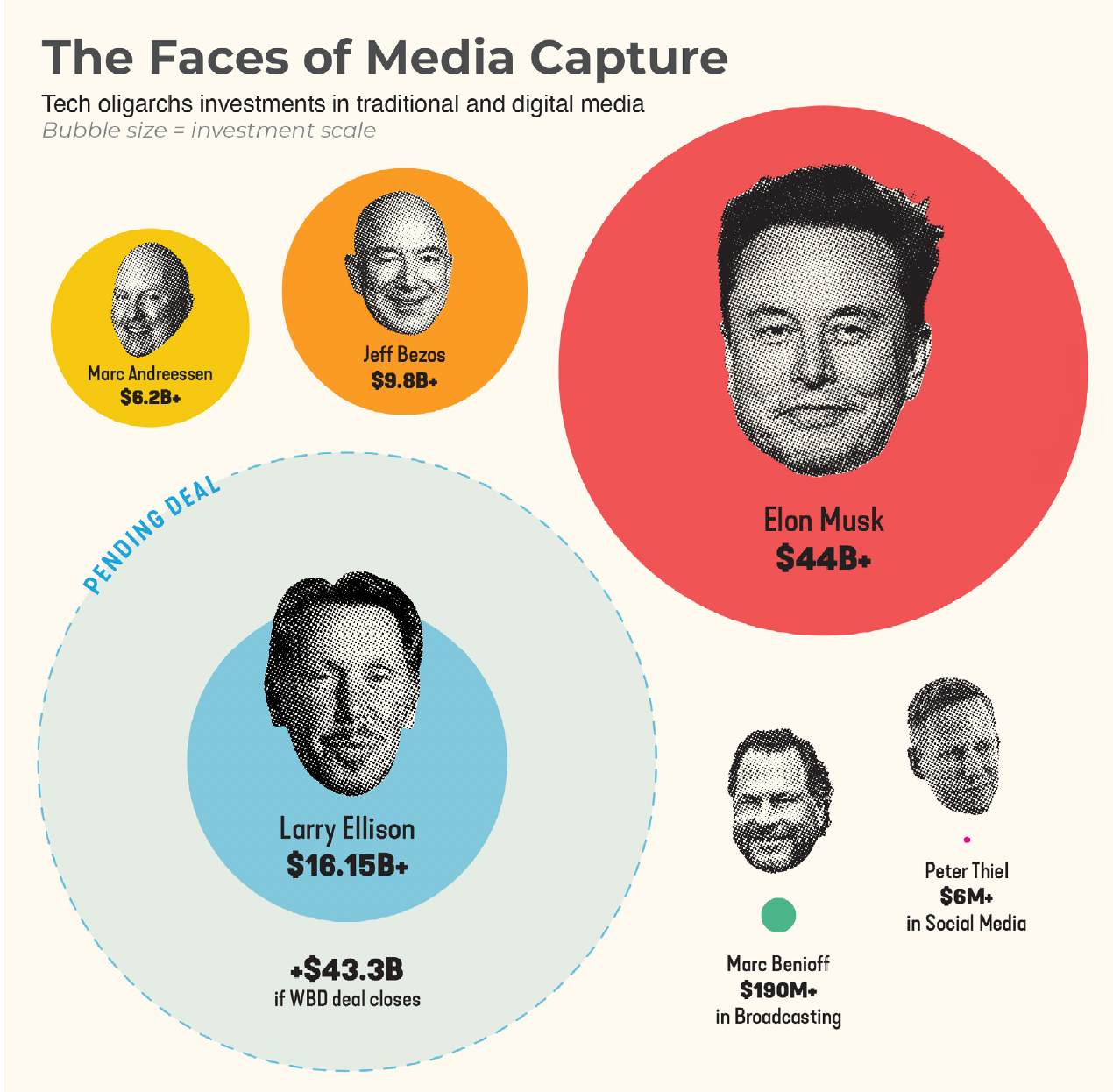
One of the key figures to emerge in this convergence is Larry Ellison, who's a longtime Trump supporter and an enthusiastic booster of the tech-powered surveillance state. How worried should we be by the fact that the Ellison family now controls so much of the country's data infrastructure and its daily narrative infrastructure?
We should definitely be worried. What makes Ellison different from your typical media mogul is that he's operating on both ends simultaneously. On one side, you have Project Stargate, a $500-billion data center project that Oracle is anchoring alongside other tech investors. On the other, you have CBS News, where in less than a year the Ellisons installed a right-wing editor, cut coverage critical of Trump, and handed the network's airtime over to administration officials to spin their version of events. Whether it's justifying ICE operations or explaining why rising gas prices are somehow good, the editorial direction is clear.
"The data centers and the newsrooms are not separate projects."
When the same family builds the surveillance infrastructure and controls the narrative infrastructure, that's a concentration of power we should take seriously. The data centers and the newsrooms are not separate projects.
Social media is now Americans' primary news source. How does the unchecked—and insidious—algorithmic control of people like Musk, Zuckerberg, Bezos, and Ellison specifically harm voters of color?
The core problem is that news stopped being the product a long time ago. Engagement is the product. And keeping people informed is a completely different goal than keeping people hooked.
Research has shown repeatedly that content provoking outrage and fear performs better on social media platforms. The algorithms keep amplifying whatever drives the most engagement, so that's what gets produced and what gets spread. And although it feels like we have more information at our fingertips than ever, most of it is junk, and it's controlled by fewer people than at any point in recent history. Early in the media justice movement, we used to talk about the six corporations that dominated the media ecosystem. That number has only gone down. A smaller group of people now shapes the daily information diet of most Americans and most of the world. That's a level of concentrated power over public understanding that we've genuinely never seen before.
There is now "a level of concentrated power over public understanding that we've genuinely never seen before."
For communities of color specifically, that means algorithmic amplification of racist content, voter-suppression disinformation, and the systematic suppression of organizing voices. Which going back to Larry Ellison, is what makes him a dangerous figure. He now has an ownership stake in TikTok and his company, Oracle, is in charge of auditing TikTok's algorithm to "retrain" it. Keep in mind that TikTok was a central platform in helping amplify the voices of Palestinians in the U.S. and abroad protesting the genocide in Gaza. We need only look at what happened on Twitter after Elon Musk took over to see glimpses of what might happen to TikTok.
As AI search results reduce clicks to news sites, major publishers like the New York Times and News Corp are offsetting their loss of traffic with massive AI licensing deals. How can smaller outlets and the Black press—which are also suffering traffic declines but without the same revenue offsets—survive in this two-tier media system?
I'm genuinely not sure they can survive within it. The two-tier system is designed to reward scale, and the outlets that built this country's most accountable journalism on policing, housing, and immigration have never had the scale to compete on those terms.
"What does distribution look like when you stop depending on platforms and algorithms that were never built to serve you?"
What I do think is that survival means getting creative about untethering from the system altogether. The Baltimore Beat is a good example. They print a weekly paper and distribute it through trusted community institutions. That's an old school move, and right now it's one of the smarter ones. The digital infrastructure that was supposed to democratize journalism has been captured. So the question for community outlets becomes, what does distribution look like when you stop depending on platforms and algorithms that were never built to serve you?
One of the impacts of consolidation for years has been that news and information about the community you're in is lacking. That's a competitive advantage I think community-based media outlets, Black- and brown-owned outlets, have. They can speak to an audience that the consolidated and monolithic media system can't. And policymakers and philanthropy looking to solve the crisis of journalism and local news should pursue solutions that pull these institutions away from the corporations that got us into this mess in the first place. Which is why in the report we call attention to the AI partnership deals between Big Tech corporations and large newsrooms. As AI becomes a growing source of revenue, you are less likely to bite the hand that feeds you. That means less accountability precisely at the moment these AI giants need to be brought to task.
Today's media-owning oligarchs are: a) prioritizing engagement over journalism; b) selling surveillance systems to the government; and c) cutting DEI programs and waging a "war on woke." How big a danger is narrative exclusion in not just the current news environment, but also in the rewriting of history in AI models and in how the future gets imagined?
None of this is happening in isolation. All of it is connected. Media, schools, and churches have always been the institutions that shape how we understand the world and our place in it. Control those, and you control more than the news cycle. You control what feels possible.
With AI, "the distortion gets baked in at the infrastructure level."
The AI piece makes that more alarming because the distortion gets baked in at the infrastructure level. When the training data for these models underrepresents Black and brown communities, or misrepresents them, or erases them entirely, that bias doesn't just show up in a single article. It gets embedded into tools that millions of people use to answer questions, make decisions, and learn about history. The fight over narrative is also a fight over whose past gets remembered and whose future gets imagined. That's always been true. AI just accelerates it.
That's why fighting data centers and pushing back on large language models is so important. It's not ceding ground to a vision of technology shaped by tech oligarchs with dystopian dreams of who belongs in the future.
What actions can each of us take—whether as media consumers, voters, or professionals—to push back against media capture? What steps can individuals take to build community power?
The first step is seeing the system for what it actually is. A captured media system serving the interests of a handful of very rich people. Once you see that clearly, you start scrutinizing the information you receive differently, and you can help the people around you do the same.
"Support what's already in your backyard... Those outlets don't survive without people actively choosing to support them."
The second is finding the trusted sources that still exist. Individual journalists, specific outlets, people doing real work even inside corporate media. They're out there. I support the work of Convergence Magazine, Truthout, and Hard Reset. I follow and support journalists like Karen Hao and Adam Becker who've written some incredibly important books about this AI moment.
And the third is supporting what's already in your backyard. There are alt-weeklies, community radio stations, public access TV operations doing something fundamentally different, usually led by the communities most impacted. Take for example, AZ Luminaria, a local news outlet in Arizona that did incredible reporting around the Amazon Data Center in Tucson. Without their reporting, the local organizing that happened which eventually led to that project getting shut down. Those outlets don't survive without people actively choosing to support them. That choice is itself a political act.
Steven Renderos (he/him) is the Executive Director of MediaJustice, a national racial justice organization that advances the media and technology rights of people of color. Find him on Bluesky at @stevenrenderos.bsky.social and LinkedIn at @stevenrenderos
Further reading:
Download the new MEDIA CAPTURE report from Media Justice
My September 2025 article: The Ministry of Propaganda
Thanks for reading and sharing! And an extra special THANK YOU to all my paid subscribers, past and present, and contributors to my "coffee fund." While paid subscriptions are always welcome, I’m continuing to offer all content free, so choosing a “free” subscription means you'll never miss an issue of UNPRECEDENTED.
To support this newsletter without subscribing, consider a one-time tip at Buy Me a Coffee.
Subscribe to Unprecedented
Subscribe to the newsletter and unlock access to member-only content.